Subterranean transit networks, metro tunnels, and underground rail corridors present unique life-safety challenges during a fire. Enclosed tunnel geometries restrict natural heat venting and air exchange, causing temperatures to rise rapidly while trapping dense smoke within passenger evacuation routes.
In an underground emergency, maintaining continuous power to emergency lighting, jet ventilation fans, drainage pumps, and voice alarm communication channels is essential for life safety. Standard electrical cabling quickly short-circuits and disintegrates under high thermal loads, cutting off critical safety systems.
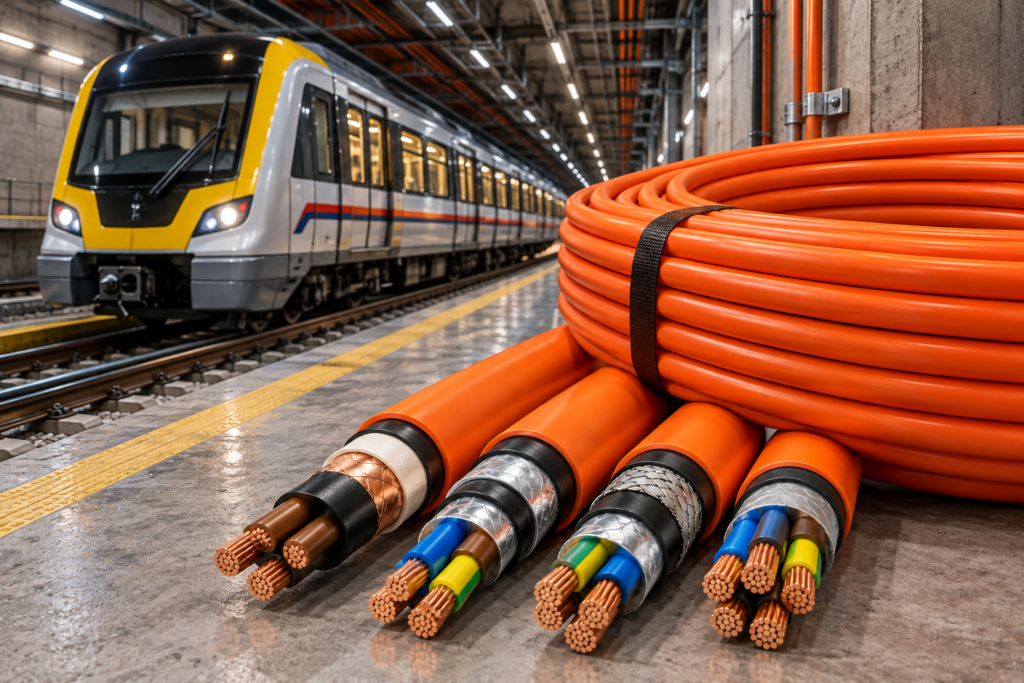
To ensure continuous operation during emergencies, transit authorities enforce the use of railway tunnel fire-resistant cables specialized cable systems engineered to maintain electrical circuit integrity even when subjected to direct flames and temperatures exceeding $950^\circ\text{C}$.
Core Construction Criteria for Fire Survival Cables
Unlike standard or flame-retardant cables which merely resist spreading fire along their length fire survival (circuit integrity) cables are built to continue conducting electricity during direct exposure to fire and mechanical impact.
High-Purity Mica Glass Tape Barriers
The core layer behind fire survival performance is a high-purity mica glass tape wrapped spirally around the individual copper conductors. When exposed to extreme temperatures 750 degree celsius to 1000 degree celsius, the outer polymer insulation layer burns away, but the inorganic mica tape vitrifies, forming a hard, non-conductive ceramic barrier that prevents phase-to-phase and phase-to-earth short circuits.
Low Smoke Zero Halogen (LSZH) Matrices
In underground tunnels, smoke inhalation poses a greater immediate threat than heat. The outer sheath and inner bedding of tunnel cables utilize zero-halogen polyolefin compounds. During combustion, these materials emit minimal light-obscuring smoke and zero halogen acid gases HCl < 0.5%, ensuring clear visibility for emergency egress and protecting sensitive signaling equipment from corrosion.
Mechanical Armoring for Debris Protection
During severe tunnel fires, structural spalling can cause concrete, steel supports, or cable tray fixtures to collapse onto cable runs. Integrated Galvanized Steel Wire Armor (SWA) or Steel Tape Armor (STA) provides the impact resistance needed to keep internal conductors intact under falling debris.
Technical Standards Matrix: Tunnel Fire Performance Ratings
The table below compares the functional behaviors and primary applications of underground transit cabling categories across international compliance standards:
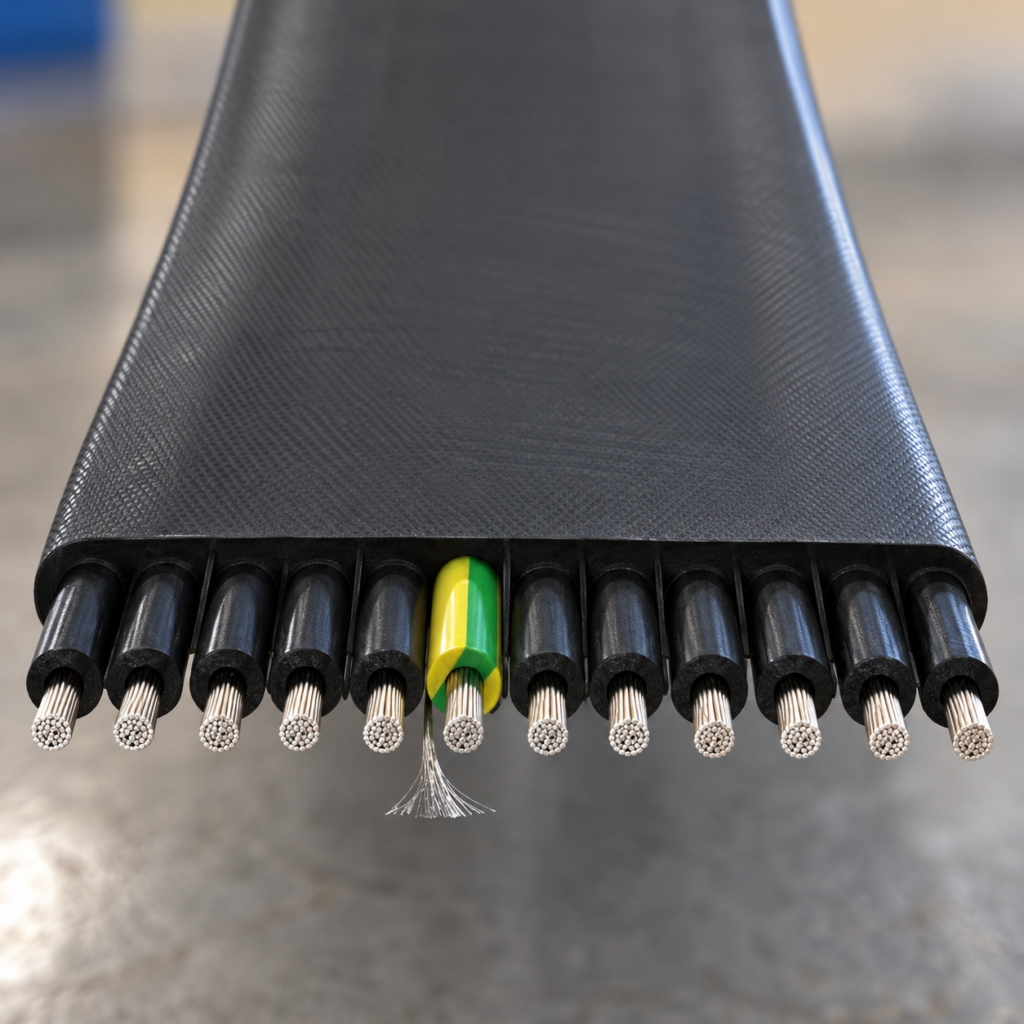
Technical Comparison: Round Multicore vs. Flat Trailing Configurations
| Cable Class | Survival Behavior Under Fire | Primary Tunnel Application | Applicable Compliance Standards |
|---|---|---|---|
| Standard PVC Cable | Fails rapidly; releases dense, dark smoke and acidic $\text{HCl}$ gas | Non-critical auxiliary lighting in open station areas | Standard IEC / BS building codes |
| Flame Retardant Cable | Resists vertical flame spread along the cable run, but circuit fails under heat | General power distribution in open station concourses | IEC 60332-1 / IEC 60332-3 |
| Fire Survival Cable (Circuit Integrity) | Maintains electrical circuit integrity under direct flame, shock, and water spray | Emergency ventilation, smoke extraction, alarms, and egress lighting | BS 6387 (CWZ) / EN 50200 / IEC 60331 |
Frequently Asked Questions (FAQs)
1. How long must a fire-resistant cable function during an underground tunnel fire?
Transit authority codes typically require cables to maintain circuit integrity for 30, 60, 90, or 120 minutes depending on system criticality (e.g., PH120 classification under EN 50200).
2. What is the significance of BS 6387 Category CWZ testing for transit cables?
It certifies that the cable can withstand three simultaneous fire hazards: direct flame at 950 degree celsius (C), water spray during fire suppression (W), and direct mechanical impact shocks from collapsing debris (Z).
3. Do fire-resistant tunnel cables require special installation hardware?
Yes, they must be secured using fire-rated stainless steel or heavy-duty metallic cable cleats and tray systems to prevent sagging and loss of support during a fire.
Safeguard Your Transit Infrastructure
Ensure full compliance with transit safety regulations and protect public transport corridors against underground fire risks. Apex Marine & Industrial Cables manufactures certified fire-survival and low-smoke cabling systems engineered to meet international transit and civil engineering codes.
Explore Transit Cable Catalog: Access technical specifications for BS 6387 CWZ and EN 50200 certified fire-resistant power, control, and signaling cables.
Consult Technical Engineering: Contact our rail infrastructure specialists to review your tunnel fire safety plan and technical project specifications.