High-throughput maritime container terminals rely on high-speed ship-to-shore (STS) gantry cranes and rubber-tyred gantry (RTG) cranes to maintain rapid cargo turnover. Operating around the clock, these heavy logistics systems travel along extended rail tracks at high velocities and accelerations, requiring uninterrupted electrical power, control signals, and fiber-optic data feeds.
Delivering energy and data to moving crane trolleys presents severe mechanical challenges. While round cables are suited for multi-directional flexing, high-speed festoon systems and motorized cable reels subject round cables to internal conductor twisting, uneven strain distribution, and corkscrewing.
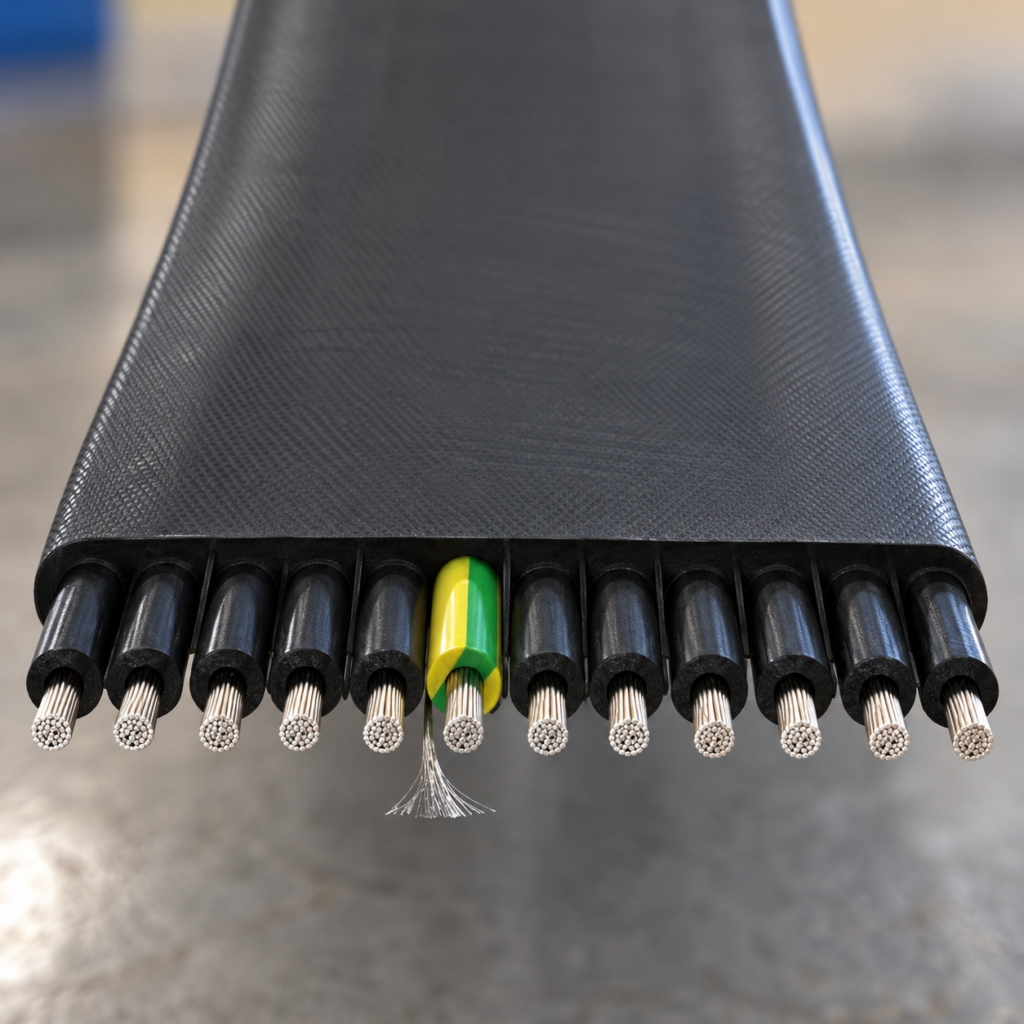
To overcome these physical limitations, heavy-duty port logistics infrastructure relies on flat trailing crane cables. Specifically designed with a planar geometry, flat trailing cables stack uniformly, bend predictably along a single axis, and eliminate mechanical stress buildup across high-speed travel cycles.
Core Mechanical Requirements for Heavy-Duty Port Cranes
Operating in exposed coastal environments, trailing cables face a combination of physical forces and environmental hazards.
Space-Saving Geometry & Compact Stacking
The flat profile allows individual cables to stack neatly on top of one another in multi-layer festoon trolleys or cable carriers. This flat alignment maximizes trolley space, minimizes dead weight, and reduces the total surface area exposed to high coastal winds, lowering wind load forces on the crane structure.
Symmetrical Mechanical Stress Distribution
Because conductors inside a flat cable are arranged side-by-side in a single parallel line, every copper strand shares the same neutral axis during bending. This design eliminates the uneven compressive and tensile forces experienced by outer conductors in spirally stranded round multicore cables.
Tear-Resistant Elastomeric Sheathing
Port crane cables operate near saltwater, grease, and industrial hydraulic fluids under intense UV exposure. Outer jackets constructed from high-grade chlorosulfonated polyethylene (CSPE), heavy-duty polychloroprene (Neoprene), or thermoplastic polyurethane (PUR) prevent gouging, tear propagation, and chemical degradation.
Integrated High-Tensile Strain Relief
To safeguard copper conductors against elongation during rapid acceleration and deceleration cycles, flat trailing cables incorporate integrated strain-relief elements such as steel wire ropes or synthetic aramid (Kevlar) cords running along the cable edges or within the central matrix.
Technical Comparison: Round Multicore vs. Flat Trailing Configurations
| Performance Metric | Round Multicore Cables | Flat Trailing Cables |
|---|---|---|
| Stacking & Tracking Behavior | Prone to twisting, overlapping, and tangling in festoons | Stacks flat and uniform; eliminates lateral crossover |
| Bending Mechanics | Multi-directional; outer strands experience uneven strain | Single-plane bending along the thin axis; uniform strain |
| Minimum Bend Radius | Larger bend radius required (10× to 12× diameter) | Compact bend radius along thin axis (3× to 5× cable thickness) |
| Wind Resistance Profile | High wind catch profile; causes festoon sway | Streamlined, low-drag profile; reduces wind-induced oscillation |
| Internal Conductor Wear | Friction between spiral layers leads to corkscrewing | Parallel layout eliminates inter-conductor rubbing |
Frequently Asked Questions (FAQs)
1. Why are flat cables preferred over round cables for crane festoon systems?
They bend predictably along a single plane, eliminating the torque, twisting forces, and internal conductor friction experienced by round cables in dynamic festoons.
2. Can flat trailing cables handle high-speed gantry travel?
Yes, engineered compounding and integrated aramid strain-relief cords allow flat trailing cables to withstand travel speeds exceeding with high acceleration and deceleration rates.
3. How does a flat cable profile reduce wind load on port cranes?
The flat, compact stack reduces the total cross-sectional surface area exposed to coastal crosswinds, minimizing wind drag and preventing trolley instability.
Optimize Your Port Logistics Infrastructure
Ensure continuous operational uptime and eliminate cable fatigue on high-speed container cranes. Apex Marine & Industrial Cables provides heavy-duty trailing and festoon cable systems engineered for maximum throughput in maritime container terminals.
Browse Flat Cable Catalog: Access engineering specifications for flat power, control, and composite fiber-optic trailing cables.
Request Technical Consultation: Contact our port equipment wiring specialists for custom festoon system design and volume procurement guidance.