Modern vessel operations rely heavily on automated engine management systems, DP (Dynamic Positioning) controls, and sensitive sensor feedback loops. However, the compact metallic environment of a commercial ship creates intense electromagnetic fields generated by high-power electric motors, variable frequency drives (VFDs), generators, and radio communication arrays.
Without targeted signal protection, electromagnetic interference (EMI) can induce noise voltages in nearby signal conductors, leading to false sensor readings, telemetry dropouts, and critical system faults. Choosing correctly engineered marine instrumentation cables with specialized shielding configurations is fundamental to maintaining signal integrity across shipboard automation systems.
Mechanics of Electromagnetic Interference in Shipboard Environments
Electromagnetic interference affects marine control lines through three primary mechanisms:
Capacitive (Electric Field) Coupling: High-voltage AC cables running adjacent to signal lines transfer unwanted voltage spikes through parasitic capacitance.
Inductive (Magnetic Field) Coupling: Large currents flowing through engine room power cables create fluctuating magnetic fields that induce noise currents in parallel signal loops.
Radio Frequency Interference (RFI): High-frequency emissions from radar systems, VHF radios, and switching power supplies radiate through shipboard spaces.
Shielding Technologies in Marine Instrumentation Wiring
To combat multi-frequency interference, high-grade marine instrumentation cables incorporate multi-layer shielding strategies:
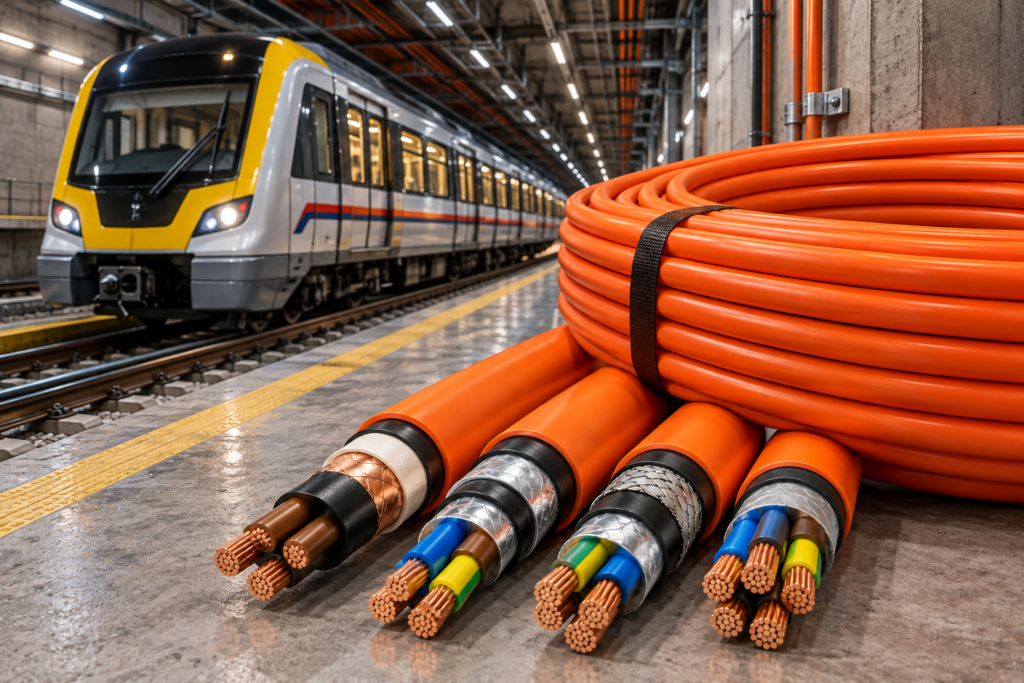
Individually Screened (IS) Pairs: Each twisted pair is individually wrapped with aluminum/polyester tape alongside a tinned copper drain wire. This prevents internal crosstalk between adjacent low-voltage sensor signals (such as 4–20 mA current loops or RTD temperature sensors).
Overall Screened (OS) Pairs/Triads: The entire cable core is wrapped in a collective shield layer, offering defense against external electromagnetic fields generated by nearby power cables.
- Tinned Copper Wire Braiding (TCWB): While aluminum foil shields provide 100% coverage against high-frequency RFI, they offer limited mechanical strength. Tinned copper wire braids supply robust mechanical protection, ground continuity, and high coverage (typically 85% to 95%) to absorb low-frequency magnetic interference.
Technical Performance Matrix: Shielding Types & Effectiveness
Technical evaluation of shielding structures for industrial and marine instrumentation cabling.
| Shielding Type | Material / Structure | Frequency Coverage | Main Advantage | Primary Marine Application |
|---|---|---|---|---|
| Aluminum/Polyester Tape (Foil) | Laminated metallic foil + Drain wire | > 1 MHz (High) | 100% physical optical coverage; lightweight | Individual pair screening (IS) in multi-pair cables |
| Tinned Copper Braid (TCWB) | Woven tinned copper strands | < 1 MHz (Low to Mid) | High mechanical strength, excellent ground path | Overall outer cable screening (OS) for heavy engine room runs |
| Combination Shield (Foil + Braid) | Foil tape layered with outer copper braid | Full Spectrum (Low to High) | Maximum noise rejection and physical durability | Critical dynamic positioning & bridge navigation sensor lines |
Frequently Asked Questions (FAQs)
1. Should marine instrumentation cable shields be grounded at one end or both ends?
For low-frequency analog signals (e.g., 4–20 mA), shield drain wires are typically grounded at one end only (usually at the control cabinet panel) to prevent ground loops. However, high-frequency digital communication lines may utilize dual-ended grounding via high-frequency capacitors to reject RFI.
2. What is the advantage of using tinned copper over bare copper for braid shields?
Tinning prevents oxidation of the individual copper strands in humid, salt-rich marine air. Un-tinned copper oxidizes rapidly when exposed to marine air, increasing inter-strand resistance and degrading the cable’s shielding effectiveness over time.
Protect Your Shipboard Control Loops
Prevent costly signal degradation and false alarms with industry-certified cabling. Apex Marine & Industrial Cables provides a broad range of DNV- and ABS-certified marine instrumentation cables equipped with high-coverage TCWB and foil shielding.
Browse Instrumentation Catalog: Access datasheets for individually screened (IS) and overall screened (OS) marine cables.
Consult Technical Engineering: Speak with our marine cable specialists to evaluate your vessel’s EMI mitigation plan.