Onboard modern commercial vessels, automated deck cranes, container handling rigs, hatch covers, and engine room gantries operate under continuous dynamic motion. The electrical cables supplying power and control signals to these machines endure persistent bending, twisting, dynamic acceleration, and high ambient vibration.
Installing rigid or improper control cables in continuous-flex applications leads to internal conductor strand breakage (known as “corkscrewing”), insulation tearing, and sudden operational stoppage. Selecting specialized flexible control cables engineered specifically for marine mechanical stress is essential to maintain uptime across automated shipboard operations.
Mechanical Physics of Dynamic Cable Fatigue
When a cable bends over a pulley or inside a cable drag chain, the outer layer of conductors experiences tensile elongation (stretching), while the inner layer undergoes compression.
Over thousands of motion cycles, standard coarse copper strands work-harden, fracture, and tear through their insulation layers. Flexible control cables overcome this through targeted mechanical design:
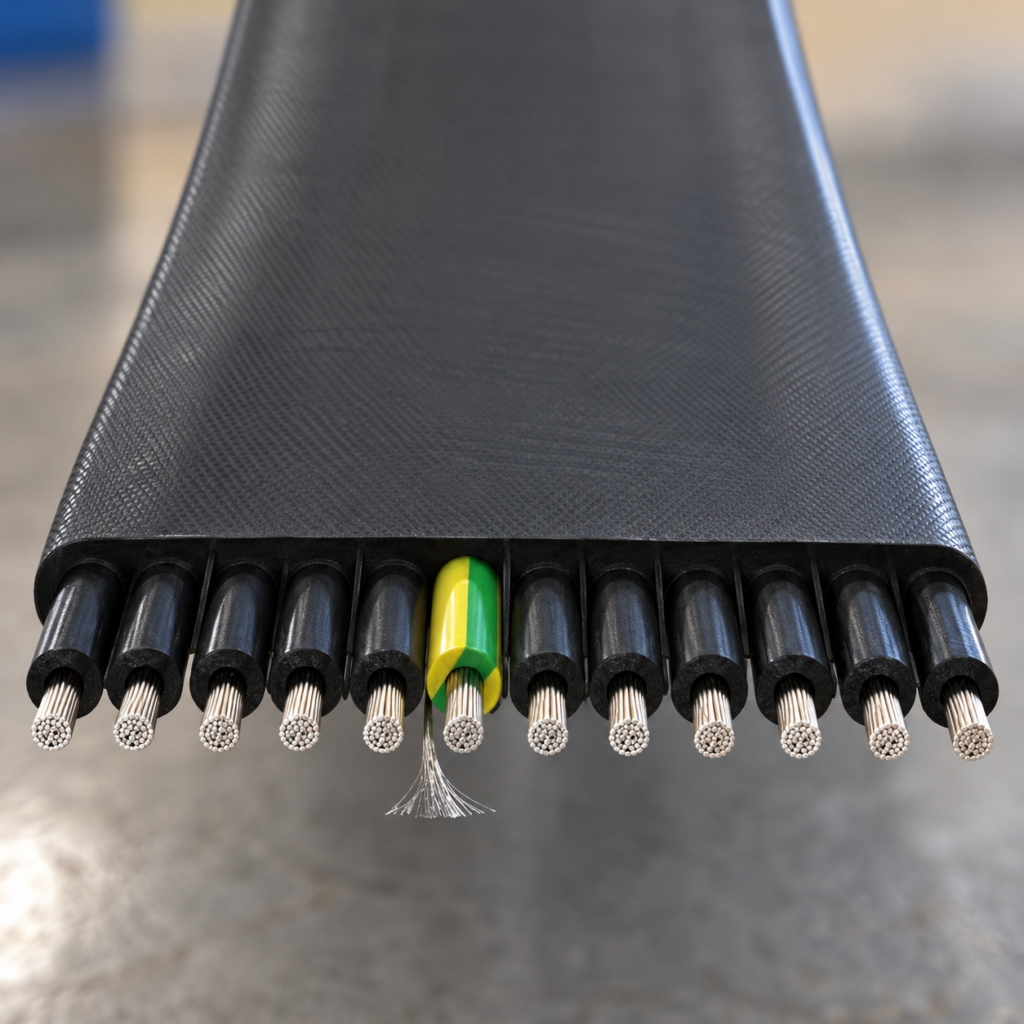
Short Lay-Length Stranding: Conductor pairs are twisted around a central strain-relief core with short pitch lengths. This allows individual copper strands to slide past one another smoothly during bending, reducing localized mechanical stress.
Central Tensile Strain Elements: High-flex marine cables incorporate high-tensile aramid (Kevlar) or synthetic fiber cores to absorb pull tension during vertical crane hoisting operations.
Key Structural Components of High-Flex Marine Cables
Polyurethane (PUR): Offers high abrasion resistance, cut propagation resistance, and flexibility down to $-40^\circ\text{C}$. Ideal for exposed deck cranes subject to sea spray and mechanical drag.
Thermoplastic Elastomer (TPE): Designed for extreme continuous flex cycles in heavy-duty drag chains and high-vibration engine automation arrays.
Cable Specification Comparison: Standard Fixed Wiring vs. Continuous-Flex Cable
| Mechanical Attribute | Fixed Installation Cable (Class 2) | Continuous-Flex Marine Cable (Class 5 / 6) |
|---|---|---|
| Conductor Construction | Concentric stranded (Fewer, thicker wires) | Super-fine annealed copper strands (0.15 mm – 0.20 mm wire diameter) |
| Minimum Bend Radius | 10× to 12× Cable Diameter | 5× to 7.5× Cable Diameter (Dynamic Flexing) |
| Flex Cycle Rating | Static use only (Fails after low flex cycles) | Tested for 1 million to 10 million flex cycles |
| Center Strain Relief | None | Integrated central aramid / synthetic tensile core |
| Outer Sheath Property | Standard flame-retardant PVC/LSZH | High-tear-resistance PUR or specialized LS-TPE |
Frequently Asked Questions (FAQs)
1. Why do standard rigid cables fail inside dynamic crane cable tracks?
Constant bending causes coarse copper strands to work-harden, fracture, and “corkscrew” inside the jacket due to metal fatigue.
2. What distinguishes Class 5 and Class 6 flexible conductors?
Class 5 uses fine-stranded copper for general machine flex, while Class 6 features even finer wire diameters designed for extreme bend radii and continuous high-speed movement.
3. How do oil and seawater affect flexible crane control sheathing?
Standard cable jackets swell and soften when exposed to hydraulic oil, or become brittle when exposed to salt water and UV radiation. Specifying PUR or TPE outer sheathing ensures resistance to oil, lubricants, salt mist, and ozone exposure.
Upgrade Your Vessel's Moving Machinery Wiring
Eliminate unexpected deck crane stoppages and cable failures. Apex Marine & Industrial Cables stocks high-performance flexible control cables designed to endure continuous dynamic flexing in severe marine environments.
View Flex Control Cable Specifications: Access datasheets for PUR-sheathed dynamic crane and automation cables.
Request Technical Selection Assistance: Contact our engineering team for assistance matching bend radii and flex-cycle ratings to your machinery.